

Lot 216A


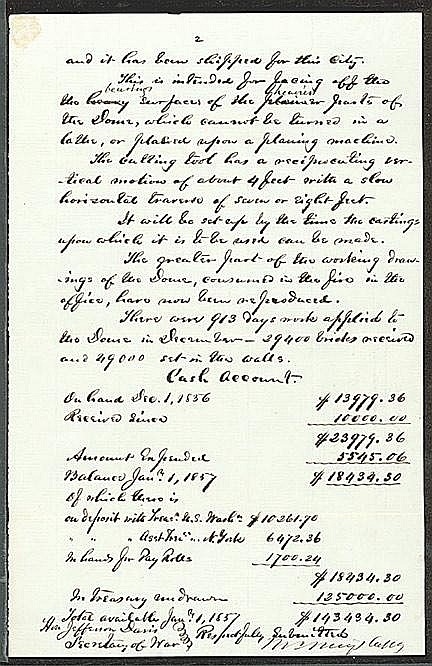

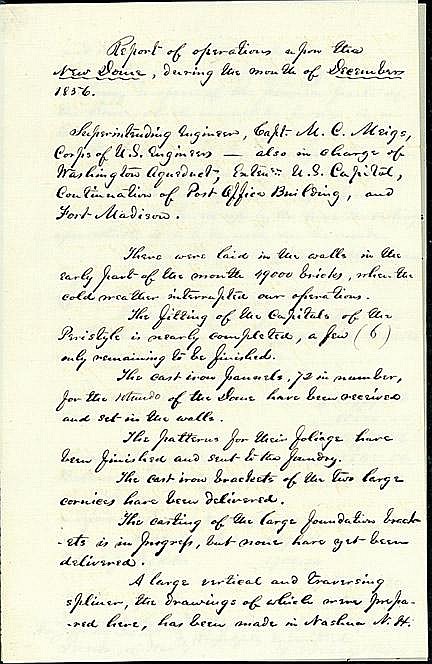
216A. THE BUILDING OF THE UNITED STATES CAPITAL Manuscript D.S. "M[ontgomery]. C. Meigs" as Superintending Engineer, two separate pages, folio, Jan. 1, 1857, also signed "Jefferson Davis, Secretary of War" in the hand of the writer, headed the "Report of Operations upon the New Dome, during the month of December 1856", and being a description of construction of the United States Capital dome and a financial statement thereof. In part: "...There were laid in the walls in the early part of the month 49000 bricks when the cold weather interrupted our operations. The fitting of the Capitals of the peristyle [a columned porch] is nearly complete...the cast iron panels, 72 in number for the...Dome have been received and set in the walls. The patterns for their foliage have been finished and sent to the foundry. The casting of the large foundation brackets is in progress...A large vertical and traversing (?), the drawings of which were prepared here, have been made in Nashua, N.H. and it has been shipped for this city. This is intended for facing off the...surfaces of the heavier parts of the Dome, which cannot be turned in a lathe. The cutting tool has a reciprocating vertical motion of about four feet with a slow horizontal traverse...The greater part of the working drawings of the Dome...have now been produced. There were 913 days work applied to the Dome in December - 29400 bricks received and 49000 set in the walls..." What follows is a financial accounting of funds available and expenditures made for December 1856. By the 1850s, Congress had outgrown its quarters, and plans to triple the size of the building were put into motion. Taking advantage of both the opportunity to revise the less-than-favored dome and the technical innovations of the previous 30 years, architect Thomas Walter came up with a new dome, along with extensions to the building. Walter proposed the use of cast iron, a fireproof material that would allow the dome to be built higher at a lower cost. In 1856, the old dome was removed, and its wood was used as fuel for a steam engine in the new construction. War broke out again in 1861, but this time it was internal. Again, the Capitol was unfinished, but instead of putting off all work, construction on the dome was pushed forward. Senate Curator Diane Skvarla says that the reason was practical: all the cast iron left on the grounds would rust if not put to use. However, with the country in upheaval, President Abraham Lincoln found himself face to face with a useful metaphor. "Here was this dome, it was being forged out of the union. The union was going to stand preserved just as the dome was continuing" Skvarla says. "He just saw this great opportunity to use this metaphor to really bring the country together". The dome finally reached completion in December 1863, topped off with a 19-foot classical bronze statue of a woman called "Freedom". Ironically, the Capitol was built using the labor of slaves who cut the logs, laid the stones and baked the bricks. The original plan was to use workers brought in from Europe; however, there was a poor response to recruitment efforts, and African Americans-free and slave-composed the majority of the work force. A significant and historical record of the construction of the building that serves as the seat of government for the United States Congress. Fine.3,000 - 4,000
Accepted Forms of Payment:
Alexander Historical Auctions LLC
You agree to pay a buyer's premium of 0% and any applicable taxes and shipping.