
Lot 504



THE FOUNDING OF LINCOLN AND CADILLAC
THE PAPERS OF HENRY M. LELAND. A comprehensive and important archive relative to the life and work of HENRY M. LELAND (1843 - 1932), machinist, inventor, engineer and automotive entrepreneur responsible for founding two of America's premier marquee luxury brands: Lincoln and Cadillac. The archive consists of over 1200 pages of manuscripts, documents, letters, telegrams, blueprints, and stock certificates signed by Leland together with fellow automotive pioneer WILLIAM T. NASH, Leland's son, WILFRED C. LELAND. Other signed documents and letters are signed GM Founder, WILLIAM C. DURANT, as well as EDSEL FORD, WILLIAM H. MURPHY, GEORGE H. LAYING, W. REX JOHNSTON, JOHN H. EMMERT and other early figures in the history of the automobile. Born in Vermont, Henry M. Leland studied the art of precision machining and worked for a number of years at Colt and other firearms manufacturers. He later became associated with the sewing machine maker, Browne and Sharpe of Providence, Rhode Island. In 1890 Leland founded the machine shop of Leland & Faulconer which produced a variety of precision instruments and parts including woodworking machines, riveting machines, and even bicycle parts. Their work with bicycle parts landed the company a contract with Ransom E. Olds to produce transmissions for his new 'curved dash' Oldsmobile at the turn of the century. The archive includes the original articles of association for Leland & Faulconer, a D.S. 4pp. legal folio, Detroit, July 9, 1890 signed by Leland, CHARLES H. NORTON, CHARLES A. STRELINGER and ROBERT C. FAULCONER. The collection also includes and 1895 amendment, the articles of association, as well as business correspondence relative to the manufacture of bicycle parts and other endeavors.
THE FOUNDING OF CADILLAC. In 1902, William Murphy and his partners at the Henry Ford Company hired Leland to appraise the company's factory and tooling in preparation for a liquidation. Leland advised against liquidation, recommending instead that the company be reorganized using the existing factory together with his engines as the basis for a new car line. The new firm was known as the Cadillac Automobile Company and in 1905 it merged with Leland & Faulconer and incorporated as the Cadillac Motor Car Company. The archive includes several D.Ss. dissolving Leland & Faulconer as well as the Cadillac Automobile Company and the transfer of subscriptions notices assigning the property of the older firms to the newly-formed Cadillac Motor Car Company (all dated Oct. 27, 1905). Some are signed by Leland, others by the entire board which included former Ford Motor Company partner WILLIAM H. MURPHY. A T.L.S of Leland's son, WILFRED C. LELAND, 5pp. 4to., Detroit, Nov. 17, 1906 to his father (who was then travelling in England) reports on the rapid progress of the new firm: "...The problems are being worked out very satisfactorily. Of course we have our ups and downs, and occasionally the personality of one individual or another cops out... We have now delivered over two hundred (200) 'H' cars, and a total of 3841 cars thus far this year.... We have made up and tested a new clutch, following the design of the clutch in the Renault car purchased by Messrs. Bowen and Murphy. It is efficient, reliable, and positive. It responds very quickly... Mr. Welch is doing some experimenting with carburetors... The assembling department is averaging seven and eight Model 'H' cars per day..." He adds at the end of the letter, "Must not stop for more at this writing, as it is Saturday afternoon, and pay day. Fortunately, we have enough to fill the… envelopes, and quite a goodly sum to spare." The company soon established a reputation for innovation including the introduction of interchangeable parts in 1908, a development that earned the company the Dewar Trophy in the same year by England's Royal Automobile Club. Cadillac was the first American automobile brand to be bestowed this coveted award and the archive includes a printed congratulatory message from Leland "To the Men in the Shop" as well as a copy of the dinner held in honor of the achievement. The same year, Leland was approached by William C. Durant, the founder of General Motors, who in pioneering his model of one car company with a variety of brands wished to include a line of cars above the price range of the Buick. After three years of bidding and negotiations, Leland agreed to sell Cadillac to General Motors for $4.5 million. Included as an exceptionally rare T.L.S. "W. C. Durant V. Prest" 1p. 4to., [Detroit], June 20, 1910, writing, in part: "...in accordance with the authority vested in me by the Board of Directors, I take pleasure in informing you that, in addition to the salary agreed upon in your contract of employment, you are also to receive jointly, each fiscal year... ten per cent of the net profits of the automobile business of the Cadillac Motor Car Company..." Under G.M.'s management, Leland's company flourished and continued to produce innovations. In 1915, Cadillac introduced the first American V8 engine that allowed cars to attain a top speed of 65 miles per hour. Interestingly the collection includes an undated 14p. typescript essay by Cadillac Advertising Director, K. P. Drysdale entitled "HOW MANY CYLINDERS SHOULD AN AUTOMOBILE HAVE?" which, after discussing the advantages and disadvantages of one, two, four and six cylinder engines ironically concludes that merely adding more cylinders would not necessarily improve engine and car performance. The V8 proved to be an enormous success AND a T.L.S. from Cadillac distributor M.S. Brigham, 3pp. 4to., Seattle, Mar. 21, 1916 remarked to Leland that "...the model 53 is doing wonderful work here. I do not know of single fault that one could find with it. A very good friend of the Cadillac...just returned from a trip from Seattle to Miami., Fla.... he stated that he had driven over 14,000 miles on one set of tires... The car is surely easy on tires, but that mileage is away above the average. There is not a Cadillac Eight-cylinder owner in this territory but what is boosting the car to the sky; they are so well pleased with their machines. The Cadillac is a good car, but this one is a whirl-wind..."
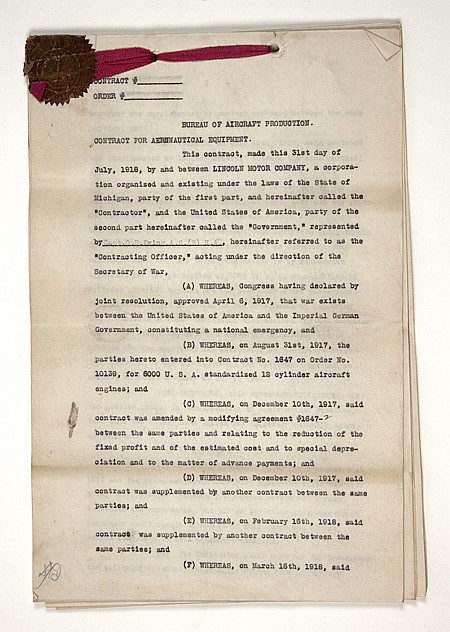
LELAND LEAVES G.M. AND STARTS THE LINCOLN MOTOR CAR COMPANY TO MANUFACTURE 'LIBERTY' AIRPLANE ENGINES As employees of G.M., Henry and Wilfred Leland enjoyed a good measure of independence. That would come to an end in 1917 with the outbreak of the First World War. In May 1917, the War Department approached General Motors, and Leland in particular, to bid on contracts to assemble aircraft engines for the U.S. Army Air Corps. Leland's people at Cadillac began a dialogue with the government over the pros and cons of various engines but it was cut short when in the summer of 1917 when Durant, a resolute pacifist, refused to allow Leland and Cadillac to manufacture military supplies. In response, the Lelands left General Motors and Cadillac and founded The Lincoln Motor Car Company. The archive includes the original "MEMORANDUM OF AGREEMENT" D.S. "Henry M. Leland", "Wilfred C. Leland", "George H. Laying", "W. Rex Johnson", and "Wm T. Nash" 5pp. legal folio, Detroit, July 31, 1917 establishing the Lincoln Motor Company together with the company's "CERTIFICATE OF INCORPORATION OF LINCOLN MOTOR COMPANY" that re-incorporated the company in Delaware (unsigned, 16pp. legal folio, Wilmington, Del., Jan. 17, 1920). The articles of agreement, a typed D.S. 5pp. legal folio, Detroit, July 31, 1917 is signed by Leland, his son Wilfred as well as WILLIAM T. NASH, GEORGE H. LAYING and W. REX JOHNSTON all of whom agree "to organize a Michigan corporation for the purpose of conducting a machine shop and of manufacturing, assembling and dealing in motors, transmissions, parts and accessories for motor cars, motor boats, motor cycles, aeroplanes, internal combustion engines, etc. etc... " The Lelands agreed to supply $450,000 as an initial investment for the fledgling company while Laying and Johnston contributed $15,000 while Nash threw in $5,000. The other portion of the financing was to be secured with a $1.5 million stock offering. The company had ready business in the form of the U.S. Government and began to supply engines for the U.S. Army air corps. The corporation was formally incorporated on August in a partly-printed D.S. "Henry M. Leland", "Wilfred C. Leland", "Gertrude Leland Woodbridge", "George H. Laying", "W. Rex Johnston", "William T. Nash", "Frank Johnson", "William H. Murphy", and four others, 4pp. legal folio, Detroit, Aug. 25, 1917, organizing the Lincoln Motor Company. The archive also includes the first stock certificate book containing eleven certificates personally signed by HENRY LELAND as well as many others signed by Wilfred Leland and William Nash. The first ten stock certificates have been removed from the book, the first (according to the stub) was for 2000 shares issued to Henry Leland and the subsequent ones issued to the various directors mentioned in the aforementioned articles of association. The same month, Lincoln entered a contract for 6,000 12 cylinder aircraft engines. The archive includes numerous letters to Leland and his subordinates from the Council of National Defense's Aircraft Production Board and the Chief Signal Officer, including correspondence while Leland was still at Cadillac. The archive includes the formal contracts between Lincoln and the government including a typed D.S. "Wilfred C. Leland" "William T. Nash" and others, 29pp. legal folio, [Detroit], July 31, 1918 that reiterates all of the advance agreements and contracts made from August 31, 1917 onward. According to Order No. 730584, dated Oct. 7, 1918, the order for "11,000 12 Cylinder Liberty Motors, at $4,000.00 each..." was worth $44,000,000 to Lincoln. Part of the agreements with the government included a provision to deed the company's property, including factories, and warehouses to the government as trustee for the "sum of One Dollar and other good and valuable considerations" as a means of security against a $5,000,000 advance. The collection includes appraisals of the various properties as well as drawings and blueprints of the same.
LINCOLN MOTOR CAR After the close of the First World War, Leland retooled his factory for the production of luxury automobiles. The archive includes correspondence from real estate agents and others concerning the purchase and disposal of properties for the company as well as blueprints of the Warren Avenue Plant and an appraisal of the same a well as the plants at Holden and Woodward Avenues. However within a few years, the company was running into financial trouble due to the transition. A typed document , 19pp. 4to., [n.p., n.d.] entitled "LINCOLN MOTOR COMPANY CHRONOLOGY" gives a useful history of the company from its final settlement with the U.S. on Apr. 18, 1919 to May 6, 1924. Even before the first 20 Lincoln cars were shipped on September 8, 1920, the company received a claim for $5,700,000 in additional taxes due. By Nov. 8, 1921 the board was already discussing placing the company in receivership and on November 14, Wilfred and Henry Leland met Edsel Ford had an initial meeting in Dearborn. In February 1922 Ford purchased Lincoln for $8,000,000 with Lincoln to remain as a distinct brand within the Ford Motor Company and assured the Lelands a good degree of autonomy. The pill was a bitter one, and the Leland's blamed their plight on a shadowy conspiracy against them that is detailed in a 28pp. typed statement by Henry Leland (and docketed in pencil by him) entitled, "STATEMENT OF THE HISTORY OF THE LINCOLN MOTOR COMPANY FROM ITS ORGANIZATION TO THE TIME OF THE LELANDS SEVERING THEIR RELATIONS WITH FORD" the company came out of its war contracting period a crippled firm due to excessive demands for taxes by the government following the war while during its time as a government contractor it was continually harassed after none other than sculptor Gutzon Borglum. Borglum believed that Edward Deeds, a Dayton man who was a member of the Aircraft Board was also a stockholder in Lincoln. Borglum complained to Woodrow Wilson concerning the apparent conflict of interest. Wilson initiated an investigation although the Lelands insisted there was no impropriety. "Notwithstanding these facts, Mr. Borglum and possibly others got up a conspiracy with the result that the Lincoln Motor Company was constantly embarrassed... our plant was over-run with spies placed there by Government authorities; false affidavits were made with regard to our methods of doing business... This strange conspiracy, which seemed to have behind it some mysterious and powerful influence, has continued to the present day, resulting in four large but fictitious claims on the part of the Treasury and War Departments against the Lincoln Motor Company... " The close of the war didn't help matters: "We had already paid the Government $4,125,000 in income taxes... " Despite the fact that the government had an army of accountants on site ensuring that all necessary taxes were paid, the company received an additional tax bill of $5,725,673.46. "This was unexpected and like a bolt of lightning from the clear sky..." High labor costs, a large number of cancelled aircraft orders, and an unworkable tax burden made the situation even worse: "Then just as things were going well and we were about to reap the reward of our well deserved skill and ability, the business depression came and we suffered the same as every other motor car maker... Under these circumstances we were forced to seek financial aid. In the meantime, certain Lincoln stockholders saw an opportunity to take advantage of our necessities and of these unsettled conditions and force us into a receiver's hands with the hope, as it developed later, to buy in the assets of the company at a comparatively trifling sum..."
FORD PURCHASES A BANKRUPT LINCOLN In the same 28 page statement, Leland recounts, in vivid detail the purchase of the company by Henry Ford who assured them that they would have independence. The party was a short one: "The delusion under which Mr. Ford's prolific assurances placed us was soon violently dispelled because on Monday morning, the 6th day of February [1922], instead of allowing us to go ahead and operate the plant in accordance with our plans and principles... the plant was overrun by Mr. Ford's group of strong-armed men acting as generals and a horde of his working Huns was sent over to the plant ripping up, tearing out, carting away all sorts of materials, chairs, stools... doing everything that could be done to disturb the organization, to destroy its efficiency and morale and to put an end to the loyalty of the heads of departments in their support of the Lelands in the management of the business. Mr. Ford and his son and a group of strong-armed pugilistic generals took certain of the heads of different departments who they had ascertained were most important in managing the business, and filled them with such tales as this: 'You are now working for Henry Ford. He is your only boss. You have one thing only to do. Find out what Henry Ford wants and do it. Pay no attention to instructions from anyone else. If you do this, Mr. Ford will make you rich and happy. This is all he will expect of you.'..." The Lelands chose to 'grin and bear it' but still the abuse and power-grab continued. A T.L.S. by EDSEL FORD, 2pp. 45o., Detroit, May 5, 1922 a recap of the latest company dictates including "...regarding the employment of Mr Jos Stringham for special work. I discussed this matter with Mr. Henry Ford and he is not in sympathy with your action in this matter. Our policy is to pick men for special jobs from within our organization entirely. This offers great encouragement to our employees, and we find that they by their contact with our various plants and operations are better able to carry out new work than an outsider... discontinue his work as soon as possible..." The Lelands efforts to cooperate were finally rewarded with their dismissal by Henry Ford in June, 1922. To add insult to injury, despite Ford's assurances that all of Lincoln's stockholders would be reimbursed, he reneged on his promise leading to a wave of letters from disappointed stockholders. The archive includes many of the letters sent to them by Henry Ford's secretary, explaining "This property was purchased at a Receivers Sale by the Ford Motor Company, which sale carried with it no obligation to reimburse the Stockholders of the former company..." There is also a 99 pp. typed statement, dated July 3, 1924 detailing Wilfred Leland's conversations with Henry Ford concerning the negotiations over the purchase of Lincoln by Ford. The Lelands filed suit against Ford in 1929 over the issue.
The archive also includes copious business records including contact sheets listing the names and addresses of hundreds of suppliers for Lincoln Motor Car together with two stock ledgers for the company; working blueprints of factories and engine components; early advertising ephemera for Lincoln and much more. Personal material includes a copious collection of family photographs including a very large set of 8x10 photographs of Leland's family and the family properties as well as a sizeable collection of candid snapshots and posed portraits including cabinet cards, cyanotypes, and silver prints as well as a monumental copperplate (12" x 9 1/2") portrait of Leland. Also included is Henry Leland's personal diaries for 1910 and 1929 as well as a binder's worth of newspapers and clippings mentioning Lincoln, Ford and the auto industry in general. Not surprisingly, Leland retained a good deal of press reports critical of Ford. Overall the archive is in very good to fine condition with the minor wear and tear expected from business papers. The entire collection has been housed in custom archival blue-cloth slipcases to ensure preservation. This archive, believed to be the largest known in private hands, represents a very important piece of automotive history, chronicling the founding of two of America's marquee car brands as well as the birth of the American auto industry.
Accepted Forms of Payment:
American Express, Discover, MasterCard, Money Order / Cashiers Check, Paypal, Personal Check, Visa, Wire Transfer
Shipping
Shipment is sent USPS priority, USPS International Express (for most overseas) or UPS Ground at the auctioneer's option, signature required, unless other arrangements are made. Handling, shipping and insurance charges will be added to the invoice in one entry. Buyer's should be aware that large, framed, fragile or odd shaped items can incur substantial shipping and packing charges. Customer's who supply their own courier account number will still be charged a handling fee.
Alexander Historical Auctions LLC
You agree to pay a buyer's premium of 22.5% and any applicable taxes and shipping.
View full terms and conditions
| From: | To: | Increments: |
|---|---|---|
| $0 | $99 | $10 |
| $100 | $499 | $20 |
| $500 | $999 | $50 |
| $1,000 | $1,999 | $100 |
| $2,000 | $4,999 | $250 |
| $5,000 | $9,999 | $500 |
| $10,000 + | $1,000 |